
What is My Child Learning at Avimor Academy?
Any parent who is away from their child all day is undoubtedly thinking “what is my child actually doing all day?”
At Avimor Academy, we want parents to feel connected to our team and confident that their child is happy, thriving, and learning things that will set them up for success in their school years ahead.
Our Preschool and Pre-K programs are designed to nurture the “whole child.” What we mean by this is that your child will experience a broad range of activities each day that develop them academically, physically, socially, emotionally, and creatively. Our daily schedule is structured to include a combination of teacher-led and student-led activities; all grounded in a play-based curriculum that encourages exploration, movement, friendships, and nonstop opportunities to practice doing things independently.
Our goal is not to turn preschool into elementary school – we view our position as early learning educators to lay the foundational skills for children to thrive when kindergarten does finally arrive.
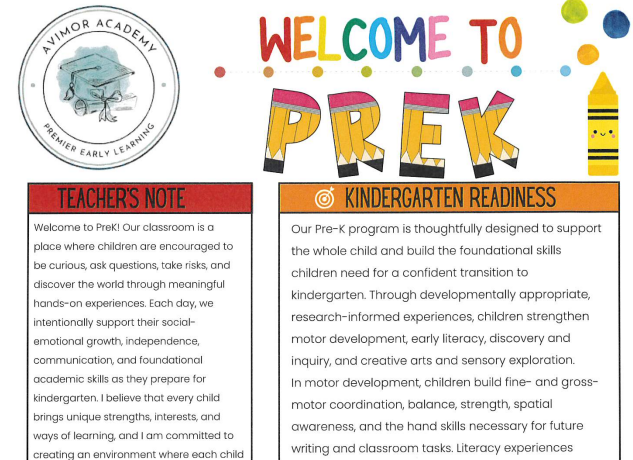
Kindergarten Readiness is More Than Academics
Most people think that ‘kindergarten readiness’ refers tothe academic part of the picture. Which it does – but readiness has more to dothan simply learning ABCs and 123s.
Our curriculum does teach early learning basics such as letter recognition, name writing, counting, and knowing shapes and colors. And just as important is the support and development of other areas such as motor development, literacy, discovery and inquiry, sensory exploration, and social-emotional (social skills) development. The early years are critical for developing fine- and gross-motor coordination, balance, spatial awareness, vocabulary, comprehension, oral language, and print awareness.
Discovery activities allow students to practice observing, asking questions, investigating their environment, solving problems, and developing early math thinking. And through all of it, children learn the very important skill of being part of a classroom community.
Being part of a classroom teaches children to listen, follow routines, take turns, share, communicate with one another, make friends, solve problems, and become increasingly independent. Working on these skills helps our little learners succeed long after preschool ends!
What Does An Actual Week Look Like?
Our Preschool and Pre-K teachers don’t necessarily treat literacy, math, science, motor skills, and creative arts as completely separate subjects. Our teachers design learning experiences in each of these domains around a common theme.
For example, one of our units is the ‘farm’ theme. The teachers will design the daily learning activities to coordinate with this theme, such as a literacy activity asking the children to build farm-related words, complete a farm animal word hunt, or practice letter sounds using farm-related words.
For math and discovery, the teachers may ask the children tocreate patterns, match numbers, count farm objects, and explore their sensesusing a farm-themed sensory bin.
Fine-motor activities might include puzzles, cuttingpractice, play-dough creations, and practicing our pencil grasp by writing lettersand farm words.
A creative arts activity might include painting a farm map,making a cow out of paper plates, or drawing a field full of fun animals the childrencan imagine on their own farm!
Even circle time connects with the theme – with activities involving stories, rhyming, counting, classroom discussion, and interactive games.
To our little learners, this all feels like playing, creating, talking, moving, and discovering. To our early educators, these activities create opportunities for our students to practice many important skills.
Learning Through Play
Young children don’t need to spend their days sitting at desks completing worksheets to learn. Yes, on occasion there is definitely a place for worksheets but we generally use those in a lesser manner when compared to other child-directed and teacher-directed activities.
Our classrooms are organized into learning centers (or stations) that encourage children to explore, make choices, solve problems, interact with others, and practice the skills laid out at those stations. Each classroom has ample learning centers in the domains of language and literacy, math, science, creative arts, motor, sensory, social emotional, and social studies.
Even in centers such as block play, our little learners have the chance to explore early engineering and spatial concepts. The pretend play (also sometimes called dramatic play) center encourages learners to build language skills, cooperate, collaborate, and sometimes even solve problems.
The bottom line is that play and learning are not competitive priorities in an early learning environment. Purposeful play is incredibly important in helping young children learn.
How Do We Know Children Are Growing?
Another important part of our school program is documenting the progress of our learners throughout the year. Our teachers use observations, developmental assessments, and individual portfolios to monitor academic, developmental, and social emotional growth over the course of their time in our program.
Rather than simply looking at what a child can or cannot do, portfolios allow us to create a collection of work that illustrates how a child progressed on a certain skill over time.
Teachers then use this information to identify strengths, recognize skills that are beginning to emerge, determine if additional support would be helpful, and plan future classroom activities. Parent-teacher conferences also give families an opportunity to discuss progress and goals with their child’s teacher.
Come See Learning in Action
A lesson plan can tell you what children are learning, but there’s nothing quite like being able to see our teachers and our little learners in action.
Booking a time with our Director to observe classrooms and watch our children build words, count objects, create art, investigate the science topic of the week, or even strengthening their hands with play-dough, is the best way for parents to see the magic that happens each and every day.
All of it is learning. And all of it is designed to give your amazing child the best educational start in life.
If you’re exploring Preschool or Pre-K options in Avimor, Eagle, or Boise areas, we’d love to show you what learning looks like at Avimor Academy.
Schedule a tour today and come see our little learners inaction.